Swarming Robots Aim to Clean Up Space Debris
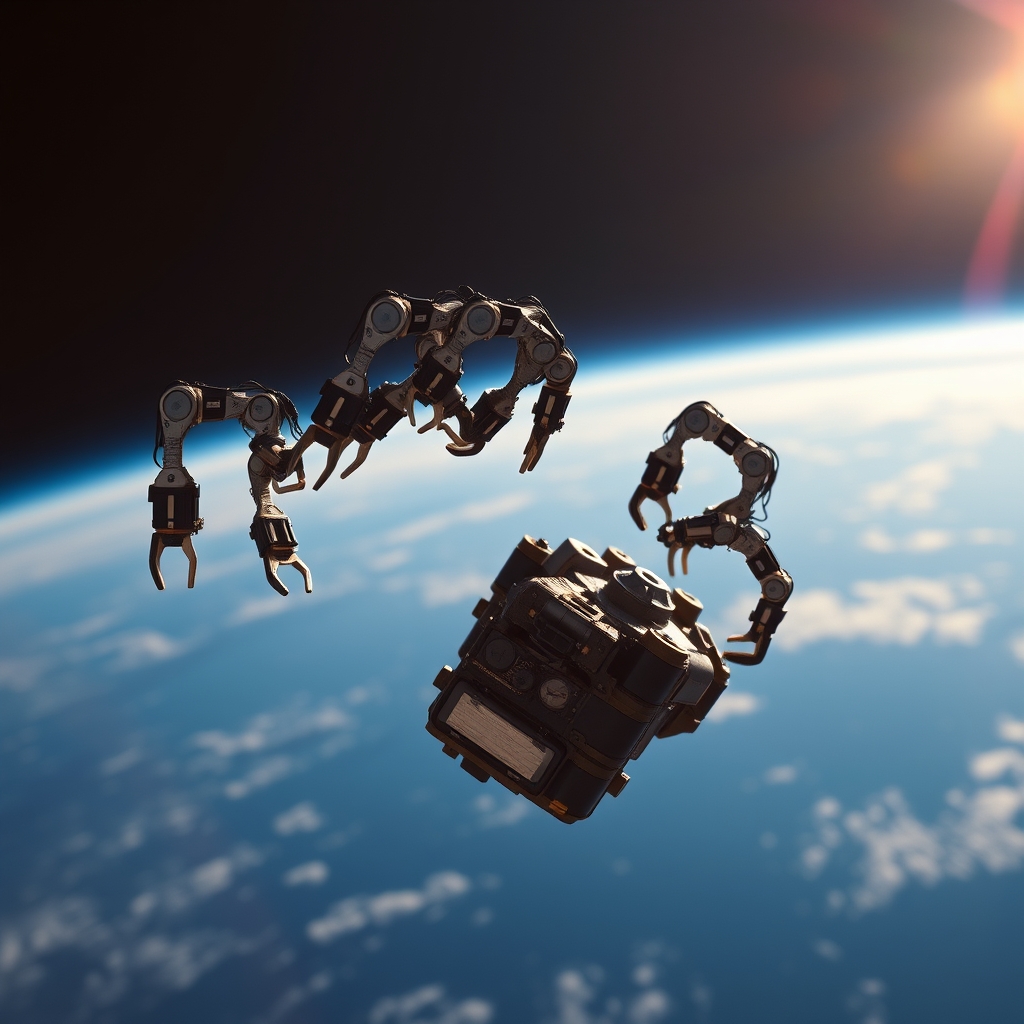
According to ESA Space Engineering & Technology, a student team from the University of Bologna has built a five‑robot swarm that can encircle and track a tumbling, non‑cooperative object in a frictionless testbed. The experiment shows how autonomous swarms could be used for active debris removal, a growing need as the number of defunct satellites and fragments climbs.
The experiment in plain terms
The Star‑bots team set up a flat floor with specialised floating platforms. Each platform rests on air bearings that blow a thin sheet of air, creating a micrometre‑scale gap that eliminates friction. In this two‑dimensional environment the robots behave as if they were weightless, mimicking the dynamics of objects in orbit. The swarm consists of five robots: three physical platforms and three virtual ones displayed on a screen. The mixed reality approach lets the team test large‑scale swarm behaviour while still receiving tactile feedback from real hardware.
Why a swarm, not a single chaser?
| Feature | Single‑chaser active removal | Swarm of five robots |
|---|---|---|
| Redundancy | Low – failure of the sole vehicle halts the mission | High – other robots can take over if one fails |
| Maneuverability around irregular objects | Limited by one set of thrusters and sensors | Multiple contact points allow simultaneous grip and torque control |
| Scalability | Adding more capability requires redesigning the whole vehicle | More robots can be added in software, preserving the same hardware design |
| Test complexity | Simpler to model, but less realistic for multi‑point interactions | More complex coordination, but reflects future missions that may need several attachment points |
The table summarises the trade‑offs that the ESA Academy Experiments Programme expects students to explore. The swarm’s ability to surround a tumbling target could, in theory, provide better control over rotation and reduce the time needed to change the object’s orbit.
The technical challenge of coordination
Coordinating five autonomous agents in a weightless environment requires each robot to estimate the target’s motion, share that information with its peers, and adjust its own trajectory in real time. The Star‑bots team achieved this by letting the real and virtual platforms exchange state data through a common software layer. In practice, such a layer would need to handle communication delays, occasional loss of signal, and the limited power budgets of small spacecraft. The experiment does not yet demonstrate how the swarm would deal with the harsh radiation and thermal cycles of low‑Earth orbit, but it provides a proof‑of‑concept for the core control algorithms.
Context: the growing debris problem and other approaches
Space debris now includes thousands of objects larger than 10 cm and millions of smaller fragments. Conventional active‑removal concepts often rely on a single servicing vehicle that docks with a target, uses a tether or a drag sail, and then de‑orbits the debris. Those methods have the advantage of a well‑understood flight heritage but suffer from single‑point failure risk. A swarm, by contrast, distributes risk across multiple cheap units. The trade‑off is that each robot must carry only a fraction of the total payload capacity, so the swarm must work together to generate enough force to change the debris’ orbit.
What actually changes – the hidden catch
The experiment proves that a mixed‑reality swarm can track a tumbling object, but it does not prove that the swarm can generate the necessary delta‑v (change in velocity) to re‑enter the atmosphere. The air‑bearing floor provides a frictionless environment, yet it cannot replicate the micro‑gravity and orbital mechanics that dictate how much thrust is needed. In practice, each robot would need its own propulsion system, which adds mass and complexity. The hidden cost is therefore the need for miniaturised thrusters, power supplies, and reliable communication hardware that can survive space. The benefit—redundancy and flexibility—only materialises if those subsystems can be built at a low enough mass budget.
Looking ahead – what to watch for
Future ESA or commercial missions that adopt swarm concepts should monitor three developments:
- Mini‑propulsion breakthroughs – electric or chemical micro‑thrusters that can fit within a 10 kg robot.
- Robust inter‑robot networking – protocols that tolerate the latency and packet loss typical of low‑Earth orbit.
- On‑orbit testing platforms – small satellites that can release a swarm in space to validate the algorithms beyond the laboratory. If any of these areas advance, the gap between a laboratory demo and an operational debris‑removal service will shrink considerably.
Practical steps for stakeholders today
- University teams should seek access to ESA’s Orbital Robotics Laboratory early, as the facility provides the most realistic 2‑D weightless testbed.
- Satellite operators can start cataloguing high‑risk non‑cooperative objects and share the data with research groups developing swarm algorithms.
- Policy makers might consider funding small‑satellite demonstration missions that carry a few swarm prototypes, to gather real‑world performance data.