Saturn’s Southern Decagon: A New Atmospheric Wave Emerges
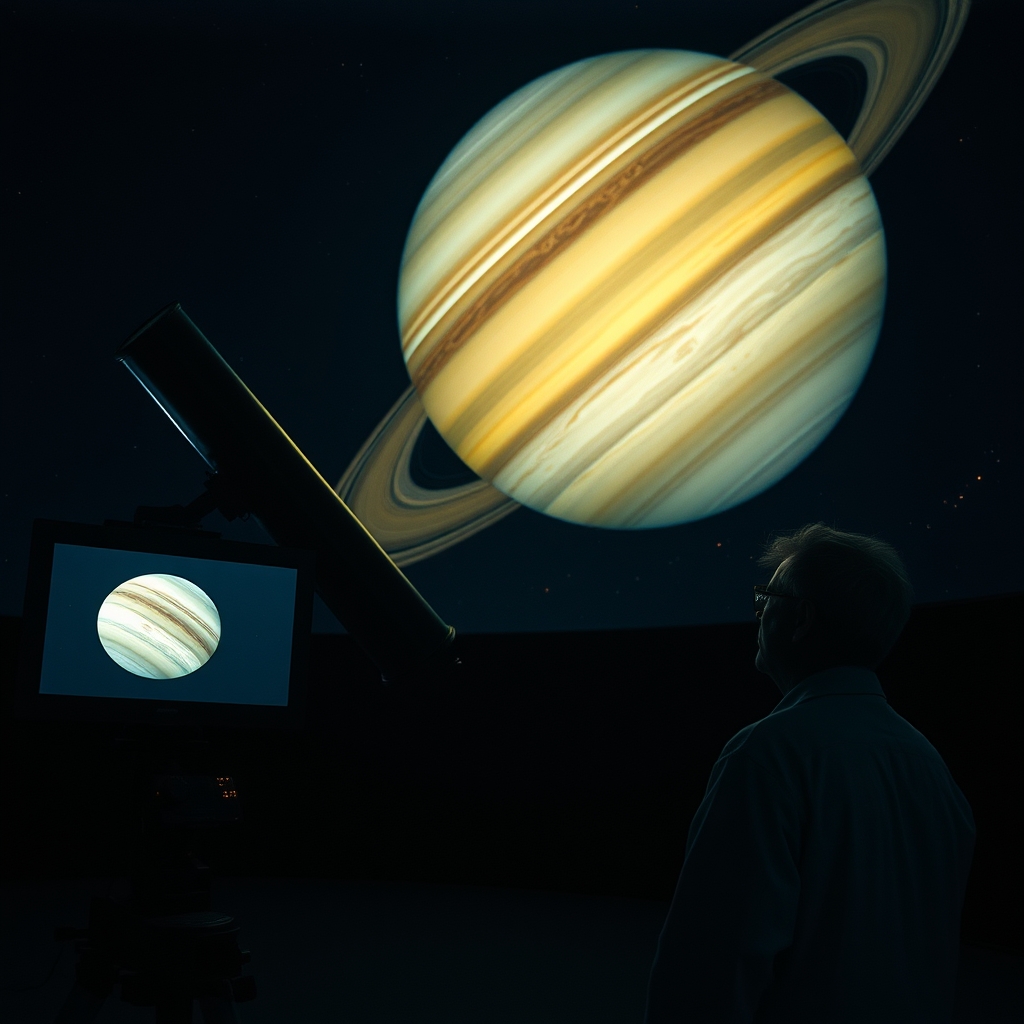
Saturn’s south pole now hosts a giant, ten‑sided atmospheric wave that has been tracked over several Earth years. The pattern, captured by the Hubble Space Telescope, mirrors the famous northern hexagon but differs enough to suggest a brand‑new atmospheric phenomenon. Understanding how and why it formed could reshape models of jet‑stream dynamics on gas giants.
According to ESA Space Science, researchers pieced together Hubble images from the OPAL (Outer Planet Atmospheres Legacy) programme dating back to 2023 and identified a clear decagonal wave encircling the southern pole. The discovery marks the first large, regular‑sided jet pattern seen in Saturn’s southern hemisphere and offers a rare window onto the birth of a planetary‑scale wave.
A ten‑sided wave appears over Saturn’s south pole
The decagon sits inside one of Saturn’s powerful jet streams and extends through multiple atmospheric layers, meaning it is not merely a surface cloud formation. Its shape is traced by alternating bright and dark bands that shift slightly with wavelength – different wavelengths probe different altitudes, so the wave’s vertical extent can be inferred. The structure became discernible in 2024 when ground‑based observers reported a subtle undulating band, and Hubble’s sharper, space‑based view confirmed a well‑defined ten‑sided pattern by 2025.
How Hubble and OPAL made the detection possible
OPAL has been photographing the outer planets annually for more than a decade, building a time‑series that can reveal slow changes. Hubble’s location above Earth’s atmosphere eliminates seeing blur, giving sub‑arcsecond resolution across an entire planetary rotation. This consistency allows scientists to compare images taken in different filters and at different times, isolating genuine atmospheric features from fleeting cloud motions.
What the decagon reveals about Saturn’s jet streams
Saturn’s atmosphere is organized into alternating east‑west jet streams that are remarkably symmetric between the north and south. The northern hexagon, discovered in the 1980s, is a standing Rossby wave – a planetary‑scale wave that arises when a jet stream is perturbed and the Coriolis force balances the pressure gradient. The new decagon appears to be a similar Rossby‑type wave, but its ten‑sided geometry indicates a different wavenumber (the number of wave crests around the circle). In practice, a higher wavenumber often means the jet is narrower or the underlying shear is stronger. If the decagon stabilises, it could imply that the southern jet has recently reached the conditions required for a standing wave, possibly due to seasonal heating as the pole emerges from winter darkness.
The trade‑off: transient pattern or nascent stable feature?
The biggest unknown is whether the decagon will persist like the hexagon, which has survived for at least four decades, or fade as a temporary response to seasonal forcing. The trade‑off lies in the balance between the jet’s shear strength and the stabilising effect of Saturn’s deep atmospheric stratification. A strong shear can lock a Rossby wave into a fixed shape, but if the shear weakens as the season progresses, the wave may disperse. What we would watch are three indicators:
- Amplitude consistency – does the contrast between the bright and dark bands stay the same over multiple rotations?
- Wavenumber stability – does the ten‑sided shape hold, or does it drift toward a different number of sides?
- Vertical coherence – do different wavelength layers continue to show the same geometry, suggesting a deep‑seated wave? If the decagon maintains these traits, it will become the second long‑lived polar jet pattern in the Solar System, forcing a revision of how we model atmospheric circulation on rapidly rotating giants.
What to watch in the coming years
The team plans continued Hubble monitoring and complementary observations with the James Webb Space Telescope, which can probe deeper infrared layers. Computer‑model simulations are also being run to test whether the decagon can emerge from the same mechanisms that produced the hexagon, or if a different instability is at play. For amateur astronomers, the Planetary Virtual Observatory Laboratory remains a gateway to submit ground‑based images; coordinated global monitoring will improve the temporal resolution between space‑based visits.
Quick comparison: Southern Decagon vs. Northern Hexagon
| Feature | Southern Decagon | Northern Hexagon |
|---|---|---|
| Number of sides | 10 | 6 |
| First detected | 2024 (ground) / 2025 (Hubble) | 1980s (Voyager) |
| Confirmed longevity | Unknown (months‑to‑years) | >40 years |
| Primary data source | Hubble OPAL + ground images | Voyager, Cassini, Hubble |
| Suggested wave type | Standing Rossby wave (higher wavenumber) | Standing Rossby wave |
Take‑away actions for enthusiasts and educators
- Start a monitoring campaign – use a modest telescope (≥8 in aperture) with a near‑infrared filter to capture Saturn’s pole during its visibility window. Upload images to the Planetary Virtual Observatory Laboratory to contribute to the global data set.
- Incorporate the decagon into curricula – illustrate how planetary atmospheres can develop large‑scale waves, contrasting the ten‑sided southern feature with the six‑sided northern hexagon to teach wave physics and seasonal effects.
- Follow upcoming releases – set alerts for new Hubble OPAL releases and JWST observation schedules; early access to raw data can enable independent analysis before peer‑reviewed papers appear.
By staying engaged now, both professional and citizen scientists can help determine whether Saturn’s southern decagon becomes a permanent fixture or a fleeting atmospheric curiosity.